San Jose residents are increasingly concerned about self-driving Uber accidents and Uber backup driver liability. Local tech ties to fatal crashes, combined with rising distraction from apps and autonomous features, highlight growing risks on our roads. Whether you’re a passenger, pedestrian, or other driver, understanding these incidents—and your rights—is crucial.
This comprehensive guide covers the dangers of distracted driving in Uber’s self-driving fleet, San Jose self-driving Uber connections, insurance complexities (updated for 2026 California law), real settlement examples, client testimonials, a step-by-step action plan, and FAQs. We’ll show you how to hold Uber accountable after an accident.
San Jose Tech Company’s Ties to Fatal Uber Self-Driving Accident
The infamous 2018 Tempe, Arizona crash—in which a self-driving Uber Volvo XC90 struck and killed 49-year-old Elaine Herzberg—involved LiDAR sensors developed by Velodyne, a San Jose-based company. The vehicle’s autonomous system failed to detect the pedestrian, and the human backup driver (Rafaela Vasquez) was distracted, watching “The Voice” on her phone.

NTSB investigations revealed shared fault: Uber’s technology shortcomings, inadequate safety protocols, and driver distraction. Velodyne later stated its sensors performed as designed, but the incident underscored risks in San Jose self-driving Uber tech deployment.
Uber has deep roots in San Jose’s tech ecosystem, yet oversight gaps persist. Similar issues could arise locally as autonomous testing evolves.
Technology’s Role in Multiplying Driver Distraction
Rideshare apps, GPS, notifications, and semi-autonomous features create constant distractions. AAA Foundation research shows drivers over-rely on tech, leading to lane drifting, ignored speedometers, and eyes off the road.
In self-driving mode, backup drivers must remain vigilant—yet cases prove otherwise:
- San Francisco Uber driver followed app navigation onto a pedestrian staircase.
- Herzberg crash: Backup driver ignored road for streaming video.
California’s “no-touch” phone law (Vehicle Code §23123.5) prohibits handheld use, with fines starting at $162 (first offense) and escalating. Distracted rideshare drivers face additional liability.


Uber Backup Driver Liability in Self-Driving Accidents
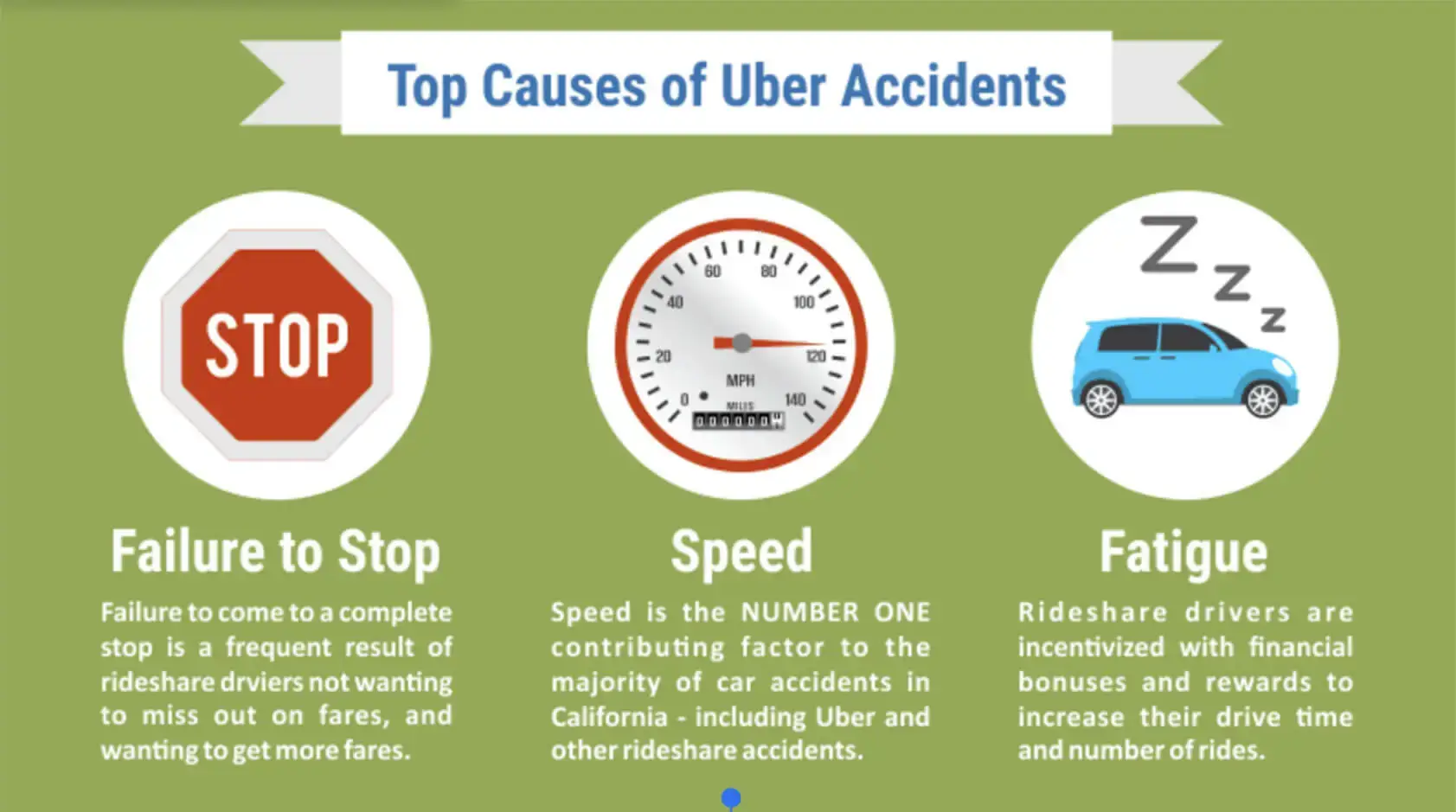
Uber backup driver liability is key in self-driving Uber San Jose scenarios. Even in autonomous mode, the human operator must intervene. Failure to do so (as in Tempe) creates negligence claims against both driver and Uber.
Uber argues tech upgrades mitigate risks, but history shows otherwise: NYT data revealed Uber’s system needed intervention every 13 miles (vs. Waymo’s 5,600). Drivers cannot blame “self-driving features”—courts hold humans responsible for road rules.
How Uber Insurance Works in Distracted or Self-Driving Accidents (2026 Update)
California requires rideshare coverage, but tiers depend on app status. Note: SB 371 (effective Jan 1, 2026) reduced uninsured/underinsured motorists (UM/UIM) from $1M to $60,000/person and $300,000/accident.
| Scenario | Uber Coverage | Key Limits |
| App off / personal use | Driver’s personal auto only | Varies by policy |
| App on, waiting for ride | Uber third-party liability + excess | $50k/person bodily injury; $100k/accident; $30k property (plus $200k excess) |
| Ride accepted / passenger aboard | $1M liability + UM/UIM + collision | UM/UIM now $60k/$300k (reduced 2026); up to car value collision ($1k deductible) |
Lyft mirrors this with minor differences. Factors like your role, passenger presence, and other vehicles involved matter. Consult a San Jose rideshare attorney immediately.
Related: How Does Uber Insurance Work? | Prop 22 Updates
Uber vs. Lyft Insurance: Key Differences
Both follow CPUC tiers, but:
- Uber: Stronger contingent collision; partners with major carriers.
- Lyft: Similar $1M liability; UM/UIM also reduced to $60k/$300k.
| Feature | Uber | Lyft |
| Period 3 Liability | $1M | $1M |
| UM/UIM (2026+) | $60k/$300k | $60k/$300k |
| Collision | Contingent (cash value) | Similar |
That’s Right—You Can Sue a Distracted Uber (or Backup) Driver
Yes. Recover medical bills, lost wages, vehicle damage, pain/suffering. Blaming “self-driving tech” is no defense. Uber often minimizes responsibility, but we maximize settlements.
Real Success: $250,000 Rideshare Bike Accident Settlement
Sally Morin Lawyers secured $250K for a cyclist struck by a rideshare driver in San Francisco (Webster & Lombard). The client suffered facial lacerations/scarring requiring surgery. We navigated low initial limits, excess policies, and medical negotiations—delivering $165K+ net after fees.
(To WSS: Create a CTA button) Read the full case
Try our free Personal Injury Settlement Calculator for an instant estimate.
Personal Injury Settlement Calculator
What Our Clients Say
Read
Sophia H.‘s
review
of
Sally Morin Personal Injury Lawyers
on
Yelp.
Read
Amy R.‘s
review
of
Sally Morin Personal Injury Lawyers
on
Yelp.
What to Do After a San Jose Uber Accident
- Seek medical help—even minor injuries worsen.
- Call 911; get a police report.
- Document: Photos, witness info, Uber/Lyft app details (ride ID, driver name).
- Report to Uber within 24 hours.
- Avoid statements to insurance without a lawyer.
- Contact attorney for free evaluation.
Frequently Asked Questions (FAQ)
Q: Can I sue Uber for self-driving backup driver distraction?
A: Yes—negligence applies to both tech and human error.
Q: Does Prop 22 affect claims?
A: Drivers remain independent contractors, but Uber’s insurance still covers active periods.
Q: What if no passengers were aboard?
A: Lower coverage tiers apply—personal policy or Uber’s limited liability.
Q: How long to file in California?
A: 2 years for personal injury.z
Free Case Evaluation Video: What Happens Next?
At Sally Morin Personal Injury Lawyers, we handle San Jose Uber accidents, distracted driving, and driverless car claims 24/7. Focus on recovery—we’ll maximize your settlement.
Call 877-380-8852 now or Get Your Free Case Evaluation online. No fee unless we win.